Korean SIM Cards Explained by a Local: eSIM, MVNO, and What Koreans Actually Use
Let me show you our household phone bills.
Me: SKT, iPhone 16 Pro Max, 110GB data plan, around ₩100,000 a month including device installment.
My wife: unlocked phone, MVNO eSIM, somewhere between ₩1,000 and ₩20,000 a month. She once caught a promotional deal and paid 100 won for a month of service. That’s about $0.07.
Same city. Same apartment. Phone bills that are worlds apart.
Neither of us is wrong. Our situations are just different — and that difference is exactly what I want to explain. Because most guides about Korean SIM cards are written by travelers passing through. This one is written by someone who was born and raised in Seoul, pays Korean phone bills every month, and buys eSIMs every time he travels abroad.
How Korea’s Mobile Network Actually Works
Korea runs on three carriers. That’s it.
- SKT (SK Telecom) — largest by subscribers, best network stability
- KT — strong 5G speeds, popular for home + mobile bundles
- LG U+ — third place, competes on price
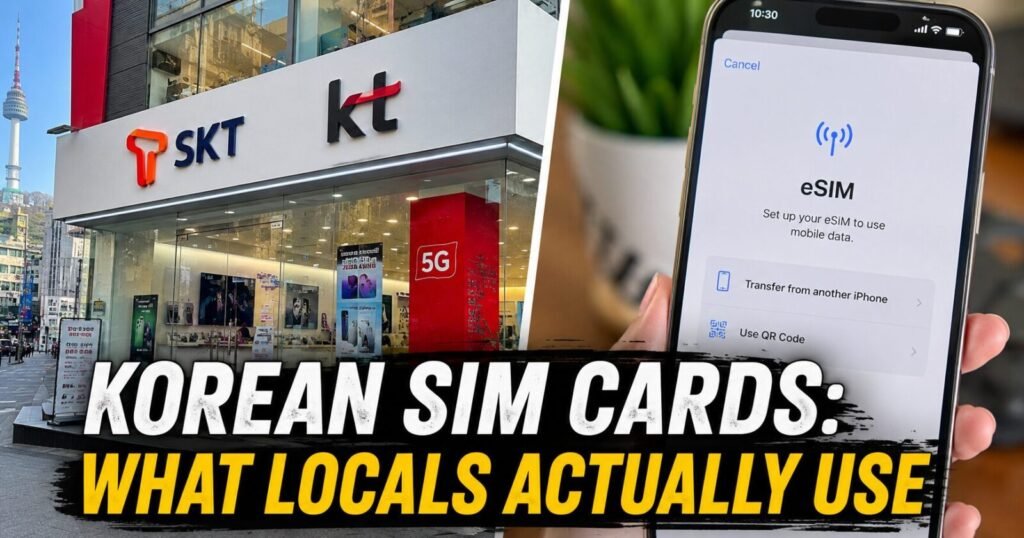
Every SIM card or eSIM you can buy as a visitor — Airalo, Saily, the tourist SIM at Incheon Airport, everything — runs on one of these three networks under the hood. The brand name on the package doesn’t change the underlying coverage.
Korea’s mobile infrastructure is genuinely world-class. 5G works in subway tunnels. It works in mountain hiking trails. I experience this every day commuting through Seoul. If your phone shows a Korean carrier signal, you will have data. That’s not something you can assume in most countries.
My Plan: SKT 110GB, Around ₩100,000/Month
Here’s exactly what I’m paying right now.
| Item | Detail |
|---|---|
| Carrier | SKT |
| Plan | 110GB + throttled unlimited after cap |
| Device | iPhone 16 Pro Max (24-month installment) |
| Monthly total | ~₩100,000 (device included) |
| Plan cost only | ~₩69,000 |
After I use 110GB, the speed drops — but data keeps flowing. I’ve never actually burned through 110GB in a single month. It’s a comfortable ceiling.
The ₩100,000 figure includes my device installment. I bought the iPhone 16 Pro Max through SKT with a subsidy, locked into a 24-month contract. Strip out the hardware cost and the plan itself is around ₩69,000.
Why don’t I switch to something cheaper? Simple: I’m under contract. Breaking it early means paying a termination fee. So I wait.
My Wife’s Plan: Unlocked Phone + MVNO eSIM, ₩100–₩20,000/Month
My wife took a different path — and it started the same way I did.
She originally bought her phone through a carrier on a 24-month contract. When that contract ended, she didn’t upgrade. She kept the same device and moved to an MVNO instead.
That decision cut her monthly phone bill by roughly 70%.
She switched entirely through eSIM. No store visit. No physical SIM card. She scanned a QR code, added it in her phone settings, and that was the end of it. The whole process took a few minutes.
Her normal monthly cost is somewhere in the ₩10,000–₩20,000 range. But MVNO providers in Korea run frequent promotional events — first few months at dramatically reduced prices. She caught one of those. For a period, she was paying 100 won a month. About seven cents.
One thing to understand about those 100-won deals: they’re promotional rates tied to a limited period. After the discount window closes, the price reverts to the standard rate. That standard rate is still cheap — usually ₩10,000–₩20,000 a month — but you should know what you’re signing up for before you see “100원” in large text and jump in.
Why Is MVNO So Much Cheaper?
MVNO stands for Mobile Virtual Network Operator. In Korean, it’s called 알뜰폰 (alttelpone — literally “frugal phone”).
MVNO providers don’t build their own towers. They buy wholesale access to SKT, KT, or LG U+ networks and resell it at lower prices. Same coverage. Same signal. Lower price because there’s no retail store network, no device subsidy program, no big marketing budget.
This is why my wife pays ₩10,000–₩20,000 for service that would cost ₩55,000–₩69,000 on a major carrier plan.
The tradeoff is that the cheapest MVNO plans usually cap high-speed data at 10–15GB, then throttle to slower speeds for the rest of the month. For someone who’s mostly on Wi-Fi at home and the office — which describes most working adults in Korea — that’s completely fine.
Phone Replacement Cycles Have Changed
This is context most guides skip.
A few years ago, Koreans upgraded phones on a tight two-year cycle, timed to contract renewals. That’s no longer the standard. People are keeping devices for three, four, even five years now. Phones are good enough. The incremental improvements between generations aren’t worth the upgrade cost.
What this means practically: the moment your carrier contract ends, your phone doesn’t suddenly become obsolete. My wife’s situation — hold the device, drop the contract, move to MVNO — is increasingly common among Korean adults who do the math.
Options for Visitors: What Actually Works
If you’re coming to Korea as a tourist, MVNO isn’t your path. Postpaid MVNO plans require an Alien Registration Card (ARC), which takes at least a few months to obtain. You need a different approach.
Option 1: eSIM — What I Use When Traveling Abroad
This is what I recommend for most visitors, because it’s what I do myself when I travel.
Before your flight, buy a Korea eSIM from Airalo, Saily, or a similar provider. You’ll receive a QR code. Scan it in your phone settings under Cellular → Add eSIM. When your plane lands at Incheon and you turn off airplane mode, your phone connects automatically.
No line at the airport. No fumbling with a physical SIM while carrying luggage. You’re online before you reach baggage claim.
For iPhone users: Any iPhone XS or later supports eSIM. Go to Settings → Cellular → Add eSIM. Keep your home country SIM active for calls and SMS (banking OTPs, WhatsApp). Set the Korean eSIM as your data line. Both work simultaneously.
Pricing: roughly $8–15 for 10GB, valid for 7–30 days depending on the provider.
One practical tip: Set up the eSIM before you board, not after you land. You can activate it on airport Wi-Fi, but doing it from home is cleaner.
Option 2: Airport SIM Card
Every major terminal at Incheon Airport has staffed booths for SKT, KT, and LG U+. At least one booth per carrier is open 24 hours. You need your passport. Activation is done on the spot. You can also pre-order KT’s tourist SIM online before you fly to skip the queue entirely.
KT’s tourist SIM is the most popular — full-speed data, no throttling at low usage. SKT’s tourist plans cap speeds at around 10 Mbps, which is usable but noticeably slower than what you’d get on a local plan.
Price range:
- Short trips (5–10 days): ₩20,000–₩35,000
- One month: ₩33,000–₩55,000
The downside is the queue, especially on weekend evenings when multiple international flights land at once. If you arrive at 11pm on a Friday, that line is going to be long.
Option 3: Prepaid MVNO — For Long-Term Visitors Without ARC Yet
If you’re staying longer than a month but haven’t received your ARC yet, some MVNO providers offer prepaid plans that accept passport-only signup. Chingu Mobile and EG SIM both have English-language interfaces and have been used by the expat community for years.
These typically run ₩20,000–₩33,000 a month for 10–11GB of high-speed data plus throttled unlimited after the cap. Significantly cheaper than airport tourist SIMs for the same duration.
For Long-Term Residents: The Full MVNO Setup
Once your ARC arrives and you’ve been in Korea long enough to know you’re staying, the move is exactly what my wife did.
If your current phone is still under contract — wait. Breaking early costs money. But once that contract expires, run the numbers. The monthly gap between a major carrier plan and an MVNO plan is often ₩30,000–₩50,000. Over a year, that’s ₩360,000–₩600,000 in savings, and you’re using the same network.
The transition is straightforward if your phone supports eSIM, which most flagship models from 2020 onward do. Sign up online, receive the QR code, scan it in your settings. No store visit required.
If you prefer a physical SIM, most MVNO providers will mail it to your Korean address within a day or two.
On promotional deals: Watch the fine print. “100원 for life” deals almost always mean the promo rate applies for a fixed period — usually 3 to 7 months — before reverting to the standard price. Still worth it, but know what you’re getting into.
Which Korea SIM Card Is Right for You
| Situation | Best Option | Monthly Cost |
|---|---|---|
| Visiting 1–2 weeks | eSIM (Airalo / Saily) | $8–15 |
| Visiting up to 1 month | KT Airport Tourist SIM | ₩33,000–55,000 |
| Long stay, no ARC yet | Prepaid MVNO (Chingu Mobile / EG SIM) | ₩20,000–33,000 |
| Long-term resident, ARC in hand | Unlocked phone + MVNO postpaid | ₩10,000–20,000 |
| Under contract, heavy data user | SKT / KT / LG U+ full plan | ₩55,000–89,000 |
One thing that doesn’t change across any of these options: you need data the moment you step off the plane. Kakao Maps, Kakao T (taxi), Naver Maps, every food delivery app — all of it requires mobile data. Korea is not a country where you can navigate on instinct and paper maps.
Figure out your option before you fly. Set it up before you land if you can. The first hour in a new country shouldn’t be spent standing in a telecom queue.