Korean Health Checkup Cost and What It’s Really Like: A Working Dad’s Honest Review
When the checkup is done, they give you a coupon.
A meal coupon — for a restaurant near the clinic. You fasted all morning for the tests, so here’s lunch on them. The first time I got one, I thought: that’s so Korean.
For foreigners, the Korean health checkup isn’t just unfamiliar because of the medical part. It’s the whole way the system is set up.
The Korean Health Checkup System: Why Workers Get One Every Year
Through the National Health Insurance Service (NHIS), Korea provides mandatory health checkups to all employed workers once every two years. Employers are required to give employees time off to get them done.
So far, not so different from other countries.
Here’s where it gets interesting. Many Korean companies go beyond the government-mandated checkup and offer their own company health checkup on top. They designate a clinic, cover the full cost, and let employees choose from a menu of additional tests — including options like sedation endoscopy and MRI.
I get mine every year through my company, at KMI Korean Medical Institute in Gwanghwamun, Seoul.
KMI Gwanghwamun Health Checkup Center: What It’s Like
KMI is a health checkup specialist — not a general hospital. They have locations across Korea, and the Gwanghwamun branch is one of the larger ones.
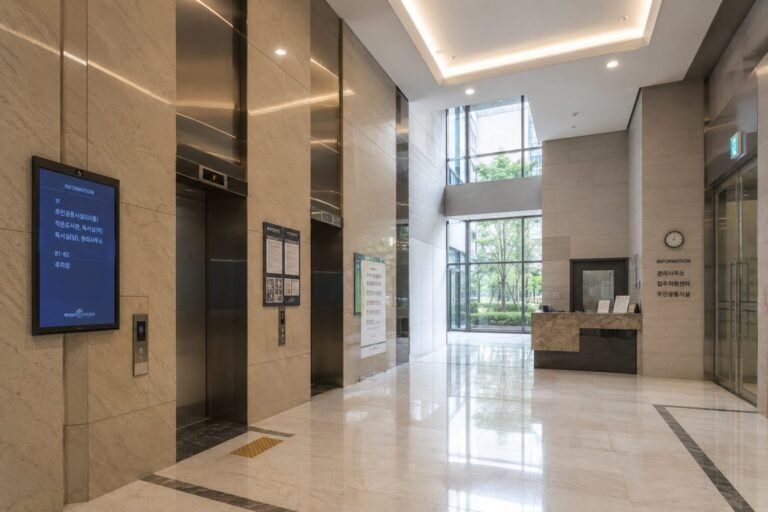
It’s been around for a long time, but went through a full renovation a few years back. Now it feels like a completely new facility. Clean, well-organized, easy to navigate.
The biggest practical advantage: everything happens inside one building. Multiple floors, each with different exam rooms, and you move through them in sequence. From check-in to the last test, you never step outside. Even with a long list of items, the flow doesn’t get complicated.
If you go during a less busy time slot, you can finish everything — including sedation endoscopy — in about three hours.
What Actually Happens on Checkup Day
You fast before going in. If you’re doing sedation endoscopy, that means nothing after dinner the night before.
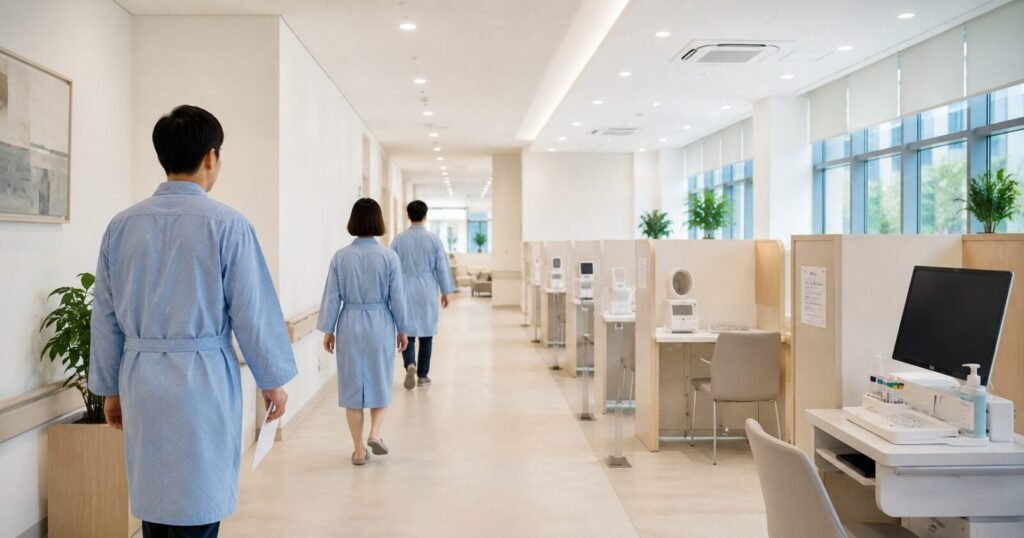
After checking in, you change into an exam gown. Then it’s a circuit of exam rooms in order — blood draw, urine test, vision and hearing, chest X-ray, ECG, abdominal ultrasound. That’s the standard flow.
Endoscopy is booked separately. You can’t schedule it on the day — it needs to be arranged in advance.
For a gastroscopy (upper endoscopy), booking 1–2 months ahead is usually enough to get the date you want. Colonoscopy is a different story. At KMI Gwanghwamun, colonoscopy slots can be fully booked 3–4 months out. I learned this the hard way — tried to book in October for a year-end checkup and couldn’t get a slot. Now I lock in the endoscopy date first, at least three months before the checkup I’m planning.
For sedation endoscopy, you’re given a sedative and the procedure happens while you’re asleep. Afterward, there’s about 30 minutes in a recovery room. That’s actually the longest single chunk of waiting in the whole visit.
Once everything is done, the front desk hands you the meal coupon. Partner restaurants near Gwanghwamun. A practical end to a morning of fasting.
Korean Health Checkup Cost: What You Actually Pay
If your company covers it, your out-of-pocket cost is zero. That’s the case for me — full cost covered by my employer.
For individuals booking directly at a specialist center like KMI, costs typically run ₩100,000–₩300,000 depending on what you include. A basic package starts around ₩100,000–₩150,000. Add endoscopy, MRI, or cancer screening panels and the number goes up from there.
The government-mandated checkup is separate. Employees enrolled in the national health insurance get this free, once every two years, at any designated clinic or checkup center. The tradeoff is that the covered items are fairly basic.
Here’s a quick comparison:
| Checkup Type | Cost | What’s Covered |
|---|---|---|
| National Health Checkup (NHIS) | Free (for insured employees) | Basic items only |
| Private checkup (individual) | ₩100,000–₩300,000 | Your choice of items |
| Company-provided checkup | Free (employer pays) | Depends on company policy |
How You Get Your Results
The results don’t come immediately. Expect to wait a few days after your checkup.
KMI sends results through three channels: KakaoTalk, postal mail, or email. KakaoTalk is the fastest and most convenient — the full results PDF arrives directly in the app.
The results sheet shows each item marked as normal, borderline, or abnormal. If anything flags as abnormal, you’ll get a recommendation for follow-up testing or a clinic visit.
For foreigners, reading the results is a real barrier. Everything is in Korean, including the medical terminology. Translation apps handle the basics, but for anything that needs clinical interpretation, you’ll want proper help.
Can Foreigners Get a Korean Health Checkup?
Yes — if you’re enrolled in Korean national health insurance, you’re eligible for the government checkup. Since 2019, mandatory enrollment has been extended to most foreign residents in Korea. You can check your eligibility on the NHIS official website.
Language support at large specialist centers like KMI Gwanghwamun is available to some degree, but it varies. Smaller clinics may have none.
One practical note for anyone considering sedation endoscopy: you cannot leave the clinic alone afterward. A companion is required. If you live alone, this is worth sorting out before you book.
An Honest Assessment
The Korean health checkup system is well-designed. One building, multiple tests, done in a morning. The cost-to-coverage ratio at private centers is genuinely reasonable by international standards. If your employer picks up the tab, there’s very little to complain about.
The meal coupon might seem like a small thing. After three hours of fasting and tests, it isn’t.
If you’ve never experienced anything like this outside Korea, the overall impression tends to be the same: more organized than expected.
Costs based on 2026 figures in Seoul. Prices vary by clinic and selected items. NHIS eligibility conditions may vary.