Why Koreans Buy So Much Bottled Water — And What We’re Actually Drinking
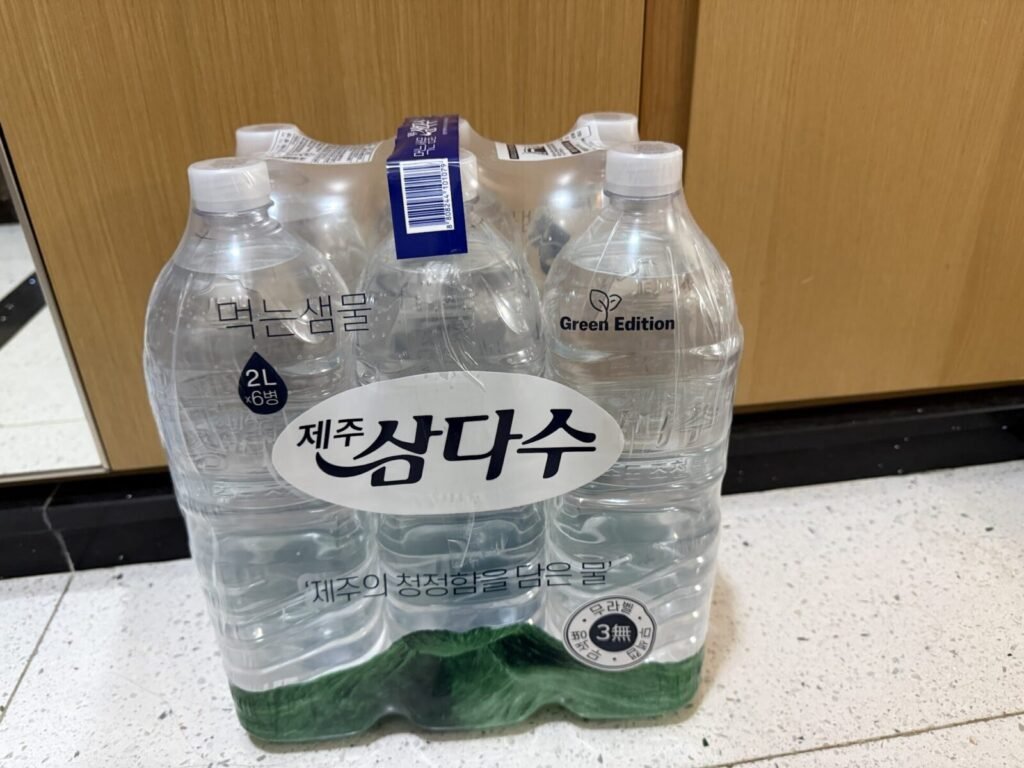
At our place, we order bottled water through Coupang or Gmarket. Place the order, and it’s sitting in front of our door the next day — two days at the latest. No hauling heavy boxes up from the parking garage.
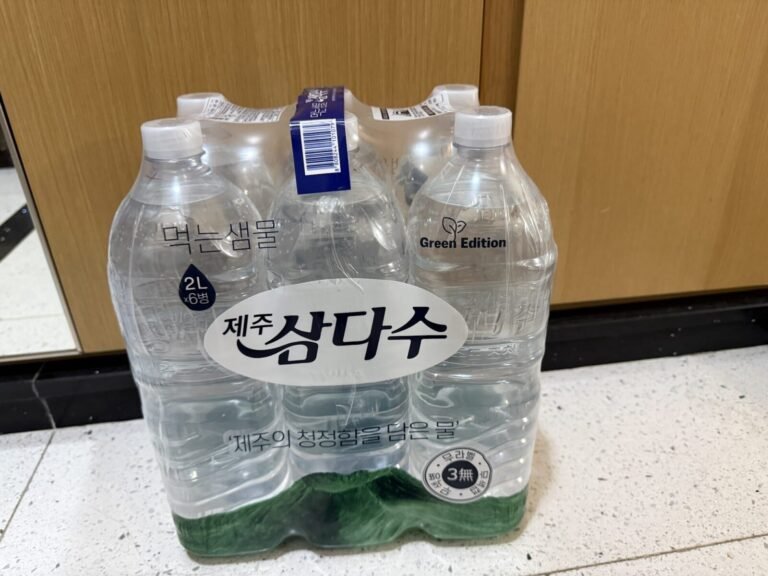
I’ll be honest: I can’t really taste the difference between brands. Water is water, as far as I’m concerned. My wife sees it differently. “Samdasoo tastes different,” she says — every single time — and so our cart almost always ends up with Jeju Samdasoo.
Our daughter carries a thermos to school each morning. When it runs out, she refills at the water purifier installed in her classroom. Most Seoul elementary schools have them.
So here’s the thing: we have a water purifier at home, purifiers at school, and tap water that the government says is technically safe to drink. And yet we still order bottled water every week. I’ve been living in Seoul for nearly 40 years, and this is just how it works. Let me explain why.
A Market That Grew 5x in a Decade
The numbers make the habit look less strange.
According to Euromonitor, Korea’s bottled water market hit ₩3.17 trillion (approximately $2.3 billion USD) in 2024 — an all-time record. A decade earlier, the market was sitting at around ₩600 billion. That’s more than a fivefold increase in ten years.
Two things drove that growth. First, the rise of single-person households: surveys show that 59.5% of people living alone drink bottled water as their primary source. Second, e-commerce delivery. Coupang launched a dedicated water delivery system in 2021, and platforms like Baemin now offer bottled water to your door in 30 to 40 minutes.
Our household is a textbook example. Two working parents, no time for a supermarket run, and an app that puts water on your doorstep by tomorrow morning. It’s not complicated.
Why Koreans Don’t Just Drink Tap Water
The first question most foreign visitors ask: “Is the tap water safe to drink?”
The official answer is yes — emphatically so. Seoul’s tap water, branded “Arisu,” is tested against 357 substances, more than twice the WHO’s recommended 166, and six times the legal minimum in Korea. The city publishes test results in real time online. By any objective standard, Seoul tap water is excellent.
And yet almost no Korean drinks it straight from the faucet.
Part of this goes back to a single event. In 1991, 30 tons of phenol leaked from an electronics factory in Gumi into the Nakdong River, contaminating the tap water supply in Daegu. Residents reported foul odors, headaches, and vomiting. It became a defining moment of public distrust — and the distrust never fully healed.
Thirty-five years later, the infrastructure is vastly improved, but the psychology hasn’t caught up. A 2024 Ministry of Environment survey found that 34.3% of people who don’t drink tap water cited contamination from aging pipelines as their reason. That concern isn’t entirely unfounded — older apartment buildings have plumbing that no government campaign can fully vouch for.
Then there’s taste. Tap water in Korea has a faint chlorine smell. Boiling removes it, but almost nobody does that anymore.
And then there’s the purifier culture. Since the 2000s, rental water purifiers — led by Coway — have become standard in Korean homes. That solved the at-home problem. But outside the home, there’s no purifier. So people buy bottles.
That’s the core dynamic: bottled water in Korea is essentially the portable version of a home water purifier.
The Brands: Who’s Actually Winning
Korea’s bottled water market looks competitive on the surface — there are over 210 brands from 60-plus manufacturers. In practice, it’s a hierarchy that barely moves.
Jeju Samdasoo — 27 Years at No. 1
Samdasoo holds approximately 40.4% market share as of Q1 2025, making it No. 1 for 27 consecutive years.
The product itself has a compelling story. Rainwater falls on Mount Hallasan on Jeju Island and takes roughly 18 years to filter down through layers of volcanic basalt rock before being drawn from aquifers 420 meters underground. No artificial processing. The result is soft, mildly alkaline water (pH 7.5–7.9) with naturally low mineral content.
The brand’s structure is also unusual. Samdasoo is produced by the Jeju Province Development Corporation — a public institution, not a private company — and distributed under exclusive contract by Kwangdong Pharmaceutical. It’s also one of the only major brands that draws from a single water source. That single-source consistency is exactly what my wife is picking up on when she says it tastes different. Brands like Icis draw from multiple locations — Sancheong, Cheongju, Sunchang — meaning the water in one batch may not taste identical to the next.
One notable development: in 2024, Samdasoo recorded its first-ever sales decline since Kwangdong took over distribution in 2012. The culprit, as we’ll get to, is the rise of private-label water.
Icis (Lotte Chilsung) — No. 2 at 13%
Icis holds roughly 13% of the market and sits firmly at No. 2. It’s the brand you’ll find most reliably at convenience stores. Price is slightly lower than Samdasoo. In 2020, Icis became the first Korean beverage brand to release a no-label bottle — a move that earned environmental credibility and, counterintuitively, grew its recognition.
Baeksansoo (Nongshim) — No. 3 at 8%
Baeksansoo sits at around 7.5–8% market share. The water is sourced from the Baekdu Mountain area on the Chinese side of the border — which some Korean consumers view skeptically, but others appreciate for its higher mineral content and distinctive taste. It has a loyal following.
Private Label — The Disruptor
PB (private brand) water from retailers like E-Mart, Coupang, and Homeplus now accounts for roughly 15% of the market. These products are often 30–40% cheaper than name brands with minimal perceptible quality difference — at least to people like me. Industry sources point to the explosion of cheap PB options as the primary reason the top three brands have all seen declining sales even as the overall market grows.
| Brand | Producer | Water Source | Market Share | What Sets It Apart |
|---|---|---|---|---|
| Jeju Samdasoo | Jeju Dev. Corp. / Kwangdong | Jeju Island, 420m volcanic aquifer | ~40% | Single source, 27-year No. 1 |
| Icis | Lotte Chilsung | Multiple domestic sources | ~13% | No-label pioneer, strong convenience store presence |
| Baeksansoo | Nongshim | Baekdu Mountain, China | ~8% | Higher mineral content, distinctive taste |
| PB Water | E-Mart, Coupang, etc. | Various domestic | ~15% | Cheapest option, fastest-growing segment |
How Koreans Actually Buy It
Online delivery (Coupang / Gmarket). This is what most urban households do, including ours. A 12-pack of 2L bottles ordered in the evening is at your door by the next morning. Given that a single case weighs over 24kg, the value of not carrying it yourself is real. Korea’s logistics infrastructure makes this seamless in a way that doesn’t exist in most countries.
Convenience stores. With CU, GS25, and 7-Eleven blanketing the country, a 500mL bottle is never more than a few minutes’ walk away. Expect to pay around ₩1,000–1,200. This is the main channel for visitors.
Supermarkets and wholesale (Costco). Buying in bulk at E-Mart or Costco is still common for households who prefer to stock up. At Costco, it’s normal to see someone loading an entire flatbed with 24-packs of Samdasoo on a weekend.
Kids and school. Our daughter’s routine — thermos in the morning, school purifier for refills — is typical. The bottled water spending for kids happens more during after-school activities and hagwon commutes, when a convenience store stop is just part of the routine.
What’s Actually Changing
The market is growing. The leading brands are shrinking. That contradiction defines where Korean bottled water is headed right now.
The gains are going to two places: private label water at the cheap end, and premium/functional water at the high end.
Sparkling water is the fastest-growing premium segment. The Trevi brand (Lotte Chilsung) has dominated this space for years, but specialty sparkling brands are gaining ground as mixing sparkling water with soju or whisky becomes more mainstream.
Functional water — added electrolytes, hydrogen water, collagen-infused — is a growing niche. You’ll see 500mL bottles priced at ₩1,500–3,000 in health-focused convenience stores, sitting next to standard bottles at ₩1,000. Whether they deliver on their claims is debatable. Whether Koreans buy them anyway is not.
Practical Guide for Visitors
At restaurants — free, safe, self-serve. Korean restaurants provide water as a matter of course. It’s almost always filtered water from a dispenser. Don’t hesitate to use it.
Hotel tap water — safe, but. New hotels have modern plumbing and the water is fine. If you’re in an older building and the water comes out slightly cloudy at first, let it run for 30 seconds. The Seoul Metropolitan Government offers a free tap water quality testing service for residents who want to check their own faucet.
Which brand to buy? Samdasoo. There’s a reason 40% of Koreans default to it. If budget matters, the supermarket PB option is genuinely fine — just know the water source may vary by batch.
Want sparkling? Trevi is the standard, widely available at any convenience store.
Carrying a reusable bottle? Worth it. Public buildings, libraries, and community centers across Seoul have free water dispensers. Schools have them too — which is exactly why our daughter’s thermos gets refilled rather than replaced with a plastic bottle every day.
Korea’s bottled water industry crossing the ₩3 trillion mark isn’t really a story about water. It’s a story about distrust that outlasted its original cause, infrastructure that still carries the ghosts of older plumbing, and delivery logistics so good that buying water online is genuinely easier than drinking what comes out of the tap.
Samdasoo has held No. 1 for 27 years because water is a category where people don’t take risks. You find something that works, and you stick with it. My wife figured that out a long time ago. I just go along with what ends up in the cart.