Korean Pharmacies: What You Can (and Can’t) Buy Without a Prescription
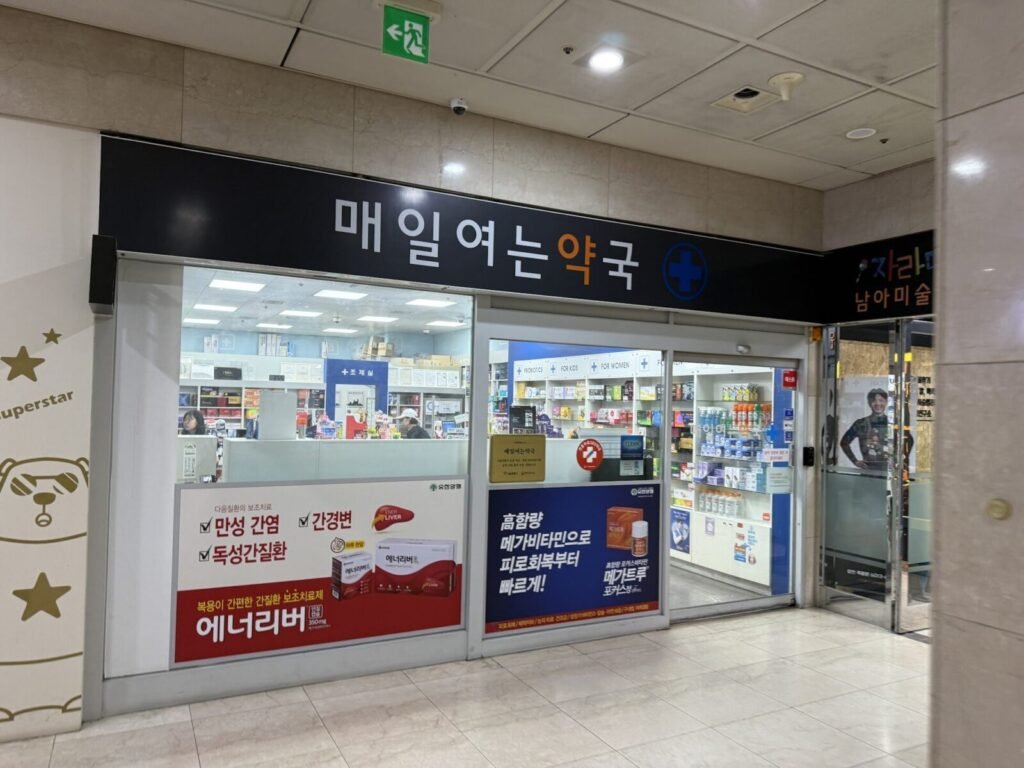
My daughter spiked a fever on a Saturday evening. That’s when I realized we were out of cooling gel patches — the kind you stick on a forehead to bring the temperature down. I grabbed my phone, searched for nearby pharmacies, and found one open until 9 PM. I called ahead. Twenty minutes until closing, they told me. I ran.
If you’re raising kids in Korea, or just living here, moments like this will happen. And if you’re a foreigner, there’s an extra layer of confusion on top: what can you actually buy without a prescription? What requires a doctor’s visit first? And what do you do when it’s midnight and everything is closed?
Here’s how Korean pharmacies actually work — from a Korean dad who uses them regularly.
How Korean Pharmacists Actually Talk to You
The first thing that surprises most foreigners about Korean pharmacies is this: when you buy medicine, the pharmacist talks to you.
Even for something as simple as a pack of Tylenol, you’ll hear: “Take this within 30 minutes after a meal.” “Don’t drink alcohol while taking this.” “No more than three times a day.” This isn’t small talk — it’s legally required. Korean pharmacists are obligated by law to provide medication counseling at the point of sale.
When you fill a prescription, there’s another layer. The pharmacy prints a detailed label on the back of the medicine bag listing every drug prescribed, the dosage, how often to take it, and any precautions. The pharmacist walks you through it before you leave. Most foreigners who experience this for the first time are genuinely surprised. It’s not common elsewhere.
If your Korean is limited, don’t worry too much. Show your symptoms through a translation app like Papago or Google Translate, and most pharmacists will work with you. In Seoul especially, plenty of pharmacists speak at least basic English.
What You Can Buy Without a Prescription
Over-the-counter (OTC) medications in Korea are called 일반의약품 (il-ban-eui-yak-pum). Here’s what’s available without a prescription:
Pain Relievers and Fever Reducers
I keep dexibuprofen at home as a household staple. It’s an ibuprofen derivative, but gentler on the stomach — which is why I prefer it over regular ibuprofen. For my daughter, I keep children’s acetaminophen syrup on hand at all times. Both are available OTC at any pharmacy.
Standard acetaminophen (sold as Tylenol and many Korean generics) and ibuprofen are freely available. One thing to watch: higher-dose versions — like Tylenol 650mg — may be classified as prescription-only. Always check the dosage, or just ask the pharmacist.
Digestive Aids and Anti-Diarrheal Medication
This is one of the most commonly purchased categories among foreigners in Korea, especially after diving into spicy food. Common OTC options include:
- Bearse (베아제) — digestive enzyme for bloating and indigestion
- 훼스탈 — another popular digestive enzyme
- Smecta (스멕타) — gentle powder for diarrhea, safe for mild cases
- Jeong-ro-hwan (정로환) — one of Korea’s oldest diarrhea remedies, still widely used
No prescription needed for any of these.
Cold Medicine
Combination cold medicines are available OTC. The catch: many Korean cold medicines contain ingredients that cause drowsiness. If you need to drive or work, tell the pharmacist upfront. They’ll point you toward a non-drowsy option.
Allergy Medication
Antihistamines for seasonal allergies or skin reactions are available without a prescription. Again, drowsiness is a common side effect — worth confirming with the pharmacist before you buy.
Oral Contraceptives
Regular birth control pills are available OTC at Korean pharmacies. Emergency contraception (the morning-after pill), however, requires a doctor’s prescription. You cannot buy it over the counter.
Topical Creams and Ointments
Two products that come up constantly among foreigners:
- Madecassol (마데카솔) — wound healing and skin regeneration
- Fucidin (후시딘) — antibacterial ointment for minor cuts and infections
Both are OTC. Korean pharmacy skincare products in general have developed a strong following among international visitors, and for good reason — pharmaceutical-grade ingredients at a fraction of what you’d pay elsewhere.
What Requires a Prescription
Antibiotics
This is where foreigners most often run into trouble. In Korea, you cannot buy antibiotics without a doctor’s prescription. Certain antibiotics are strictly prescription-only — walking into a pharmacy and asking for one won’t work.
This catches people off guard, especially those coming from countries in Southeast Asia or elsewhere where antibiotics are sold freely over the counter. If your throat is sore or a wound looks infected, you need to see a doctor first. Head to a local 내과 (internal medicine clinic) or 이비인후과 (ENT clinic), get examined, get your prescription, then take it to the pharmacy.
High-Dose Pain Medication
Standard doses of ibuprofen and acetaminophen are OTC. Certain high-dose formulations are classified as prescription-only. If the standard dose isn’t working and you’re looking for something stronger, see a doctor.
Some Eye Drops
Basic artificial tears are available without a prescription. Eye drops containing antibiotics, or those used for conditions like glaucoma, require a prescription.
Sleeping Pills and Controlled Substances
Prescription only, no exceptions. If you were taking prescription medications in your home country and need to continue in Korea, you’ll need to see a Korean doctor for a new prescription. They won’t simply honor a foreign prescription.
Convenience Store Medicine Is Not the Same as Pharmacy Medicine
Late at night, when pharmacies are closed, convenience stores are your fallback. GS25, CU, 7-Eleven, and Emart24 all carry basic medications — Tylenol, digestive aids, pain patches.
But there’s an important distinction. Convenience store medicines are a separate product category, specifically licensed for convenience store sale. Even if the brand name looks the same as what you’d find at a pharmacy, the formulation or dosage may differ. Think of it as a limited emergency option, not a full substitute for pharmacy medication.
How to Find a Pharmacy Open at Night or on Holidays
Most Korean pharmacies align their hours with nearby clinics. When the clinic closes — usually around 7 or 8 PM — the pharmacy tends to close too.
That Saturday evening when my daughter had a fever, I found an open pharmacy by searching on Naver Maps. Here’s what works:
Naver Maps search. Search “약국” (pharmacy), then filter by “영업 중” (open now). This shows you which pharmacies are currently operating. If it’s close to closing time, call ahead before you run — I learned that lesson firsthand.
The duty pharmacy system (당번약국). Korea designates duty pharmacies (당번약국) by district, ensuring at least one pharmacy per area stays open on nights and public holidays. You can find the current duty pharmacy through the Health Insurance Review & Assessment Service website or the 약학정보원 app. On major holidays like Chuseok or Lunar New Year, this is your most reliable option.
A Few Practical Notes
You don’t need to know the medicine name. Describe your symptoms — or show them through a translation app — and the pharmacist will recommend something appropriate. This is one of the genuine strengths of the Korean pharmacy system.
No health insurance means full price. Short-term visitors aren’t covered by Korea’s National Health Insurance. That said, Korean medication prices are low by international standards. Most OTC products run ₩2,000–₩10,000.
Look for the green cross or the character 약. Pharmacies are everywhere in Seoul — you’ll almost always find one within walking distance of a subway exit.
Korean pharmacies are more accessible than many foreigners expect. You don’t need an appointment. You don’t need to know exactly what you need. Show up, describe what’s wrong, and a trained professional will help you figure it out. The one exception is antibiotics — those always need a prescription. Keep that in mind, and you’ll navigate Korean pharmacies just fine.