Private vs Public Elementary School in Korea: What It Actually Costs
On the day of the lottery, I watched the draw live on YouTube.
I saw numbers being pulled on my phone screen. A police officer stood to one side of the frame — there to officially confirm the process was fair.
But the live stream ending didn’t mean I got the result right away. The acceptance text came about two hours after the draw. Those two hours felt longer than expected. Some parents who didn’t get in apparently filed complaints.
That’s how you get your child into a private elementary school in Seoul.
If you’re not from Korea, that sentence probably raises a lot of questions. Why a lottery? Why does a police officer need to be there? Why are Korean parents going through all of this just to get a six-year-old into first grade?
Here’s the honest answer — with actual numbers.
Why Private Elementary Schools Exist in Korea
Korea’s public school system is not bad. It’s free, compulsory, and by international standards, academically strong. Yet every year, tens of thousands of Seoul parents compete for private elementary school spots. Not because public schools are failing.
Because they want more.
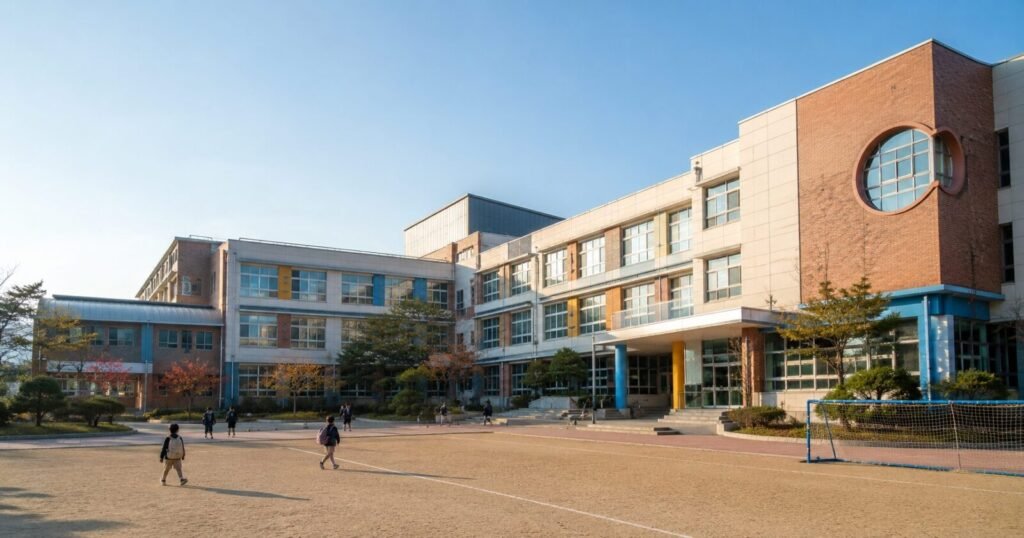
Private elementary schools (사립초등학교) follow the national curriculum. Kids learn the same core subjects as public school students. The difference is density — more English instruction, more extracurricular programs, tighter school management. What many parents describe as a system that simply runs better.
Our reasons were similar. We wanted a more structured educational environment, and experiences our daughter wouldn’t easily get at a standard neighborhood school.
Whether that’s worth the cost is a question every family has to answer for themselves. But what the cost actually is — that I can tell you clearly.
How the Private School Lottery Works in Korea
Before getting to money, the lottery deserves its own explanation. It’s the part that surprises most people.
Seoul private elementary schools don’t select students by grades, interviews, or family background. Admission is pure lottery. The Seoul Metropolitan Office of Education oversees the entire process. Since 2026, applications go through a unified platform called the Private Elementary School Admission Portal (사립초 입학포털), run by the Seoul Private Elementary School Association. The draw is broadcast live on YouTube, with results sent by text message.
The police officer isn’t a formality. It’s an official certification that the process is clean.
Before COVID, parents and children attended the draw in person. The problem was that families could only apply to one school, meaning a child could watch themselves get eliminated on the spot. The emotional toll was considered too high. The shift to online draws in 2021 solved that.
The competition is real. Before COVID, the average acceptance ratio at Seoul private elementary schools was around 1.8:1 to 2:1 — most applicants got in. When online applications opened up and families could apply to multiple schools at once, that changed fast. By 2023 the average ratio hit 12.6:1. The city capped applications at three schools per child, which brought it down to 7.8:1 in 2024. Popular schools still regularly exceed 10:1.
We were somewhere inside those numbers — watching the live stream, waiting for a text.
Private Elementary School Cost in Korea: The Real Numbers
This is the part Korean parents rarely talk about openly. I’ll just say it directly.
Tuition alone runs ₩600,000–₩700,000 per month. Add meals, textbooks, and supplies, and the real number goes higher. Add hagwon after school, and it goes higher still. We chose hagwon over the school’s after-school programs.
When you add everything up, the annual total comes to around ₩12,000,000.
On top of that, there are one-time costs. Private school uniforms are not cheap — budget ₩300,000–₩500,000 for the full set including summer, winter, gym clothes, and bag. Field trips and activity fees are billed separately throughout the year.
Public elementary school, by comparison, charges no tuition. School meals are free or subsidized depending on the district. The real costs there are supplies, occasional trip fees, and whatever hagwon you add on top.
What You Actually Get for the Money
I’m not going to rationalize the decision here. Just be honest.
The structured environment is real. The way teachers communicate, how programs are run, how school administration operates — it feels more put-together than what I hear from parents at public schools.
English education is noticeably different. Private schools have more English instruction hours and often employ native-speaking teachers. For families where English exposure matters, this is a genuine difference.
The facilities are better. Not dramatically, but they’re cleaner and better maintained.
The peer group is different. It’s uncomfortable to say out loud, but Korean parents factor this in. Families with similar levels of investment in education tend to cluster together.
What you don’t get: a shortcut. Kids at private elementary schools still go to hagwon after school. Academic pressure doesn’t disappear. If anything, parent expectations can be higher, which creates its own kind of exhaustion.
What Public Elementary School Is Actually Like
Public school isn’t a consolation prize. It’s free, it follows the national curriculum, and individual teachers can be just as good as those at private schools.
Classes typically start around 8:30 AM. Younger grades finish by 1–2 PM, older grades by 3–4 PM. Subjects include Korean language, math, science, social studies, English (from Grade 3), PE, music, and art. Class sizes have been shrinking due to Korea’s declining birth rate — the national average was around 21 students per class as of 2023.
For working parents, after-school care (돌봄교실) is available at most public schools and heavily subsidized. Private schools don’t always cover this.
The real gap isn’t academic quality. It’s program density and English instruction intensity.
The Part Nobody Says Out Loud
There was something I didn’t expect. The lottery process itself changes how you think about the whole decision.
We applied knowing we might not get in. We genuinely thought public school would be fine. But watching the live stream and waiting for a text made the whole thing feel much bigger than it probably needed to be.
Other parents say the same thing. Some of the demand for private elementary school comes from real quality differences. But some of it is anxiety — the feeling that everyone else is applying, so you should be too. The same anxiety that drives hagwon enrollment and study hours at every other stage of Korean education is already operating at age six.
If you’re a foreigner new to Korea or a parent trying to figure out the school system, here’s what matters: public elementary school in Seoul is a legitimate choice. Private school comes with real costs, requires surviving a lottery, and doesn’t guarantee a better outcome for your child.
But if what private schools offer matches your priorities — and the cost isn’t a strain — it’s not an unreasonable path either.
We got through the lottery. Our daughter is four months into her school year. She goes to hagwon after school. She still likes school.
That’s the most honest thing I can say.
Costs based on the 2025–2026 school year in Seoul. Figures vary by school. Public school meal and supply costs vary by district.