Where to Go When Your Child Is Sick at Night in Korea — After-Hours Clinics, 24-Hour Clinics, and ERs Explained
Every parent raising a child in Korea eventually faces this moment. It’s 8 p.m. Your kid’s forehead is burning. The thermometer reads 38.5°C. The neighborhood pediatric clinic closed two hours ago. Where do you go?
This is one of the most disorienting situations for foreign parents living in Korea. The healthcare system here is genuinely world-class — but if you don’t understand the structure, you’ll end up at a major hospital ER by default. Longer waits. Significantly higher costs. And often, completely unnecessary for what your child actually needs.
Here’s what I’ve learned from raising a child in Seoul and dealing with this firsthand.
Understanding Korea’s Healthcare Structure
Korea’s medical system is organized into three tiers.
Primary clinics (의원, uiwon): These are neighborhood-level clinics — your local pediatrician, internal medicine doctor, ENT specialist. This is where you should go first for most illnesses. National Health Insurance (NHI) applies, costs are low, and wait times are short.
Secondary hospitals (병원, byeongwon): Mid-sized general hospitals. For cases that require hospitalization or specialist referral.
Tertiary hospitals (상급종합병원): The big university hospitals — Asan Medical Center, Samsung Seoul Hospital, Severance. These handle serious and complex cases.
The problem is evenings and weekends. Most primary clinics close by 6 or 7 p.m. Clinics that run extended evening hours exist, but they’re not common. So when your child gets sick after hours, it can feel like your only option is the ER. It isn’t.
Two Real Options for After-Hours Care
Option 1 — After-Hours Clinics
Some pediatric and internal medicine clinics operate on weekends or extended evening hours. This isn’t a government-designated system — each clinic sets its own schedule. But they exist, and finding one makes a significant difference.
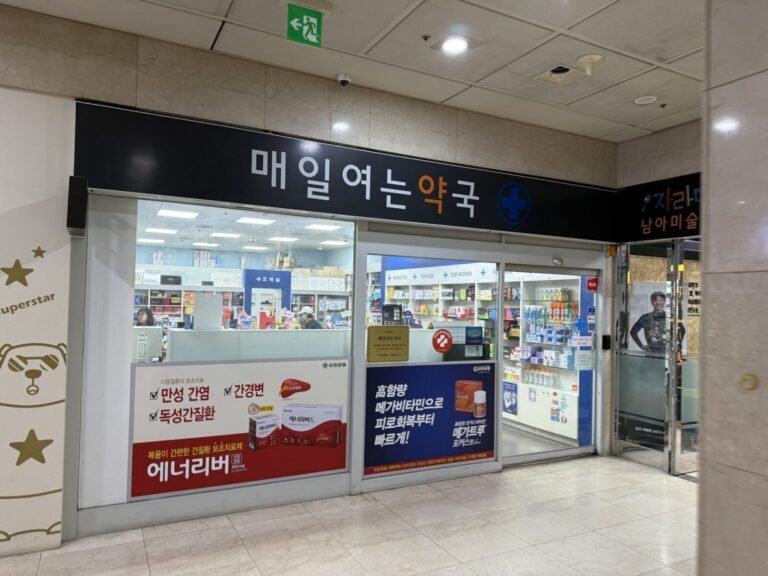
Earlier this year, my daughter developed a high fever on a weekend. Our regular pediatrician was closed. I searched on Naver Maps and found a pediatric clinic inside Eunpyeong Mall in Eunpyeong-gu. The wait was about 30 minutes. After the examination, the doctor decided she needed an IV drip — and we were able to get it administered right there in the clinic, on the spot.
That last part is worth noting. Getting IV treatment at a small neighborhood clinic on a weekend, without a hospital admission — this is the kind of practical capability that makes Korea’s healthcare system genuinely useful for families.
The costs are slightly higher than a regular weekday visit. A weekend or holiday surcharge (휴일진료수당) is added on top of the standard consultation fee. The total will vary depending on what treatment is needed, but even with the IV drip included, the out-of-pocket cost under NHI was a fraction of what an ER visit would have run.
How to find one: Search “주말진료 소아과” (weekend pediatric clinic) or “야간진료 소아과” (after-hours pediatric clinic) on Naver Maps. Always call ahead to confirm hours before making the trip.
Option 2 — 24-Hour Clinics
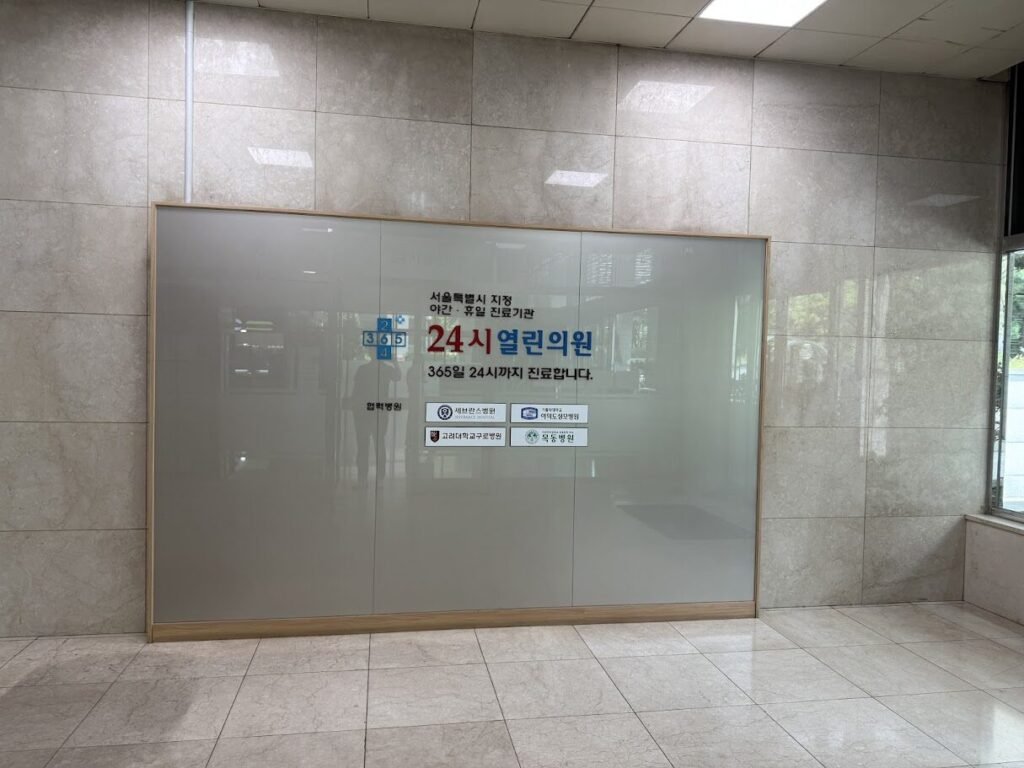
Separate from the after-hours clinic system, there are private clinics in Seoul that operate 365 days a year until midnight or later. The one I’ve used directly is 24 Hour Yeollin Clinic (24시열린의원).
There are four locations in Seoul: Gwangjin (near Konkuk University), Mokdong, Jamsil, and Mapo (Sangam). The Mokdong branch is at the Hyundai Dream Tower in Yangcheon-gu, a two-minute walk from Exit 2 of Omokgyo Station. It covers internal medicine, pediatrics, ENT, orthopedics, and more. Hours are 9 a.m. to midnight daily, including public holidays.
The Mokdong branch holds an official Seoul Metropolitan Government designation as an after-hours and holiday clinic (서울특별시 지정 야간·휴일 진료기관), and maintains referral partnerships with major hospitals including Severance and Korea University Guro Hospital.
I visited the Mokdong branch last autumn. One thing to know going in: the wait can be long. I waited close to an hour. For a clinic that’s open this late, that’s not surprising — there’s essentially no competition at midnight. Factor that into your plan and go early if you can.
The practical upside is the pharmacy right next door. After getting a prescription, you can fill it immediately without hunting for an open pharmacy at night. With a sick kid in tow at 11 p.m., that matters more than it sounds.
Official website: 24clinic.kr
When to Go Straight to the ER
After-hours clinics and 24-hour clinics are the right call for most situations — fever, cold, mild gastroenteritis, earache. But some symptoms require an emergency room immediately.
Go to the ER without hesitation if your child shows any of the following:
- Fever in an infant under 3 months old (38°C or above)
- Febrile seizure (convulsions)
- Difficulty breathing, or lips turning blue
- Loss of consciousness or unresponsiveness
- Severe dehydration (no urination for 12+ hours)
- Repeated vomiting after a head injury
Call 119 or go directly to the nearest emergency medical center. When the call connects, say “English please” or “Interpreter please.” The dispatcher will connect you to an interpreter via a three-way call. There may be a brief pause while the connection is made — stay on the line. English, Japanese, and Chinese interpretation are available.
If you’re not sure whether the situation requires an ER at all, call 1339 first. This is Korea’s 24-hour non-emergency medical information line, available in English and other languages. Staffed by medical professionals, it can help you assess the situation and point you to the nearest appropriate facility.
What It Actually Costs
If you’re enrolled in Korea’s National Health Insurance, after-hours care is far more affordable than most foreign parents expect.
| Type of visit | What to know |
|---|---|
| Weekday primary clinic | Standard NHI rates apply |
| Weekend / holiday primary clinic | Standard rate + holiday surcharge added |
| 24-hour private clinic | Similar to primary clinic; some non-covered items billed separately |
| University hospital ER | Emergency management fee added on top; costs increase significantly |
For foreign residents: long-term visa holders can enroll in NHI as a local subscriber (지역가입자). Dependents of NHI workplace subscribers are also covered under the same plan. For enrollment details, the National Health Insurance Service website (nhis.or.kr) has English-language support.
Practical Resources to Save Before You Need Them
Finding after-hours clinics:
- Naver Maps — search “야간진료 소아과” or “주말진료 소아과”
- Emergency Medical Portal e-gen (e-gen.or.kr) — real-time ER bed availability and after-hours clinic search
1339 — Non-emergency medical information line: Available 24 hours in English and other languages. Call when you’re not sure whether your child needs a clinic visit or an ER. Staffed by medical professionals who can assess the situation and direct you to the right facility.
Ai-ansim Talk (아이안심톡): A 24-hour online pediatric consultation service staffed by emergency pediatric doctors. Useful when you’re not sure whether a clinic visit is actually needed.
119 — Emergency services: For life-threatening emergencies only. When the call connects, say “English please” or “Interpreter please” and the dispatcher will connect an interpreter via a three-way call.
Save the location of your nearest weekend-hours pediatric clinic to Naver Maps the week you move in. When your child is running a 39°C fever at 9 p.m. on a Saturday, you won’t have the headspace to search.
This post reflects personal experience living in Seoul and is not a substitute for professional medical advice.