Korean Convenience Stores Are Not Just Convenience Stores
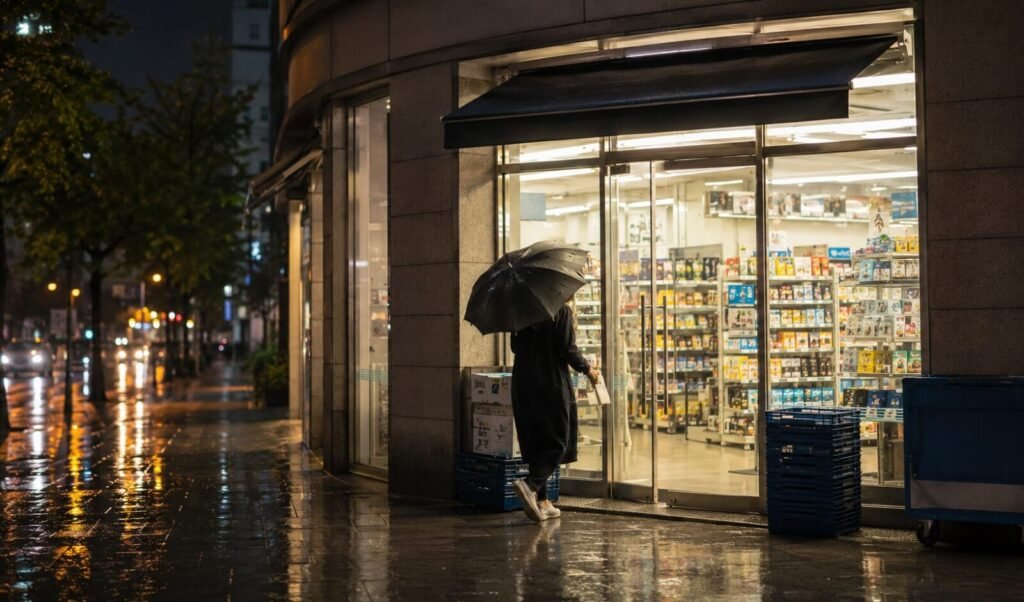
I go to a convenience store two or three times a week. Not always for a specific reason. Maybe I ran out of gum, or I want something to drink, or I feel like grabbing a beer on the way home from work.
I spend somewhere between 200,000 and 300,000 won at convenience stores every month. When I first did the math, even I was surprised. But it makes sense. In Korea, convenience stores have become part of the background of daily life — always there, always open, always useful.
Other countries have convenience stores too. But Korean convenience stores are different. They are not just places to buy things. They are where you send packages, pay utility bills, eat a meal, and pick up secondhand goods you bought from a stranger online.
How Korean Convenience Stores Work — and Why They’re Unlike Anything Else
The two brands you will see everywhere in Korea are CU and GS25.
Seven-Eleven used to be common, but these days it is hard to find one. Walk down almost any street in Seoul and you will pass a CU or a GS25 within a minute. In my experience around central Seoul, GS25 seems to show up more often.
Both brands have their own private label product lines. GS25 has the Youus series, CU has HEYROO. These in-house products are popular among office workers because the quality is decent and the price is lower than name brands.
The Beer Deal That Koreans Never Stop Talking About
One of the reasons I keep going back is the beer promotions.
GS25 and CU both run regular discount events on alcohol. The deal I buy most often is four cans of 500ml beer for 12,000 won. That works out to 3,000 won per can — cheaper than most supermarkets when the promotion is running.
Korean convenience store beer deals are one of the first things foreigners discover when they arrive. The four-can bundle discount runs so frequently that it is almost always available in some form. If you drink beer at home, it is worth checking the convenience store app before heading to the supermarket.
Eating Inside a Korean Convenience Store
Korean convenience stores have eat-in areas. There are tables and chairs, a microwave, and a hot water dispenser for instant noodles.
During COVID, eating inside convenience stores was banned entirely. That restriction has been fully lifted. Things are back to the way they were.
Walk into a convenience store after school hours and you will often find middle and high school students sitting at the counter eating instant noodles — buldak ramyeon with a slice of cheese melted on top, a triangle kimbap on the side. That is what after-school life looks like for a lot of Korean teenagers.
A bowl of ramyeon and a roll of kimbap comes to around 3,000 won. It is hard to think of many places in the world where that kind of meal is possible at that price.
Half-Price Delivery — The System That Changed How Koreans Do Secondhand Deals
Convenience store parcel services are now basic infrastructure in Korea. But there is one specific service that most foreigners do not know about: 반값택배, or half-price delivery.
My wife sells and buys things on Danggeun Market regularly. When she sells something, I go to the convenience store and send it through half-price delivery. When she buys something, I go back to pick it up. Sending and receiving both happen at the convenience store. It has become a routine.
Standard courier delivery brings the package to the recipient’s front door. Half-price delivery works differently. You drop it off at a convenience store, and the recipient picks it up from a convenience store. In exchange, the cost is roughly half of standard delivery — around 2,500 won for small items.
There is one more advantage that matters. You do not enter the recipient’s home address. You only input a convenience store location code. That means you can send something to a stranger without knowing where they live, and they never see your address either. For anyone doing secondhand transactions with people they have never met, that level of privacy makes a real difference.
Beyond Shopping: What Korean Convenience Stores Actually Do
Beyond buying things, convenience stores cover a surprising number of daily tasks.
Utility bills can be paid at the counter. Bring the paper bill, hand it over, done. ATMs are available at most locations, which matters when you need cash late at night and banks are closed.
Some convenience stores also have multifunction printers. You can bring a USB drive or connect through an app and print documents on the spot. For anyone who has ever needed to print something urgently on a weekday morning, this is more useful than it sounds.
Open at 2am. Open on Holidays. Open in the Rain.
The real reason Korean convenience stores feel different is the hours.
It is 2am and you are hungry. Convenience store. It is a national holiday and nothing else is open. Convenience store. It starts raining and you have no umbrella. Convenience store.
According to data from South Korea’s Ministry of Trade, Industry and Energy, the number of convenience store locations in Korea exceeded 55,000 in 2024. In central Seoul, it is harder to find a block without one than to find a block with one.
Foreigners who are new to Seoul often use convenience stores as a kind of home base. Lost — walk into a convenience store. Hungry — walk into a convenience store. Something needs sorting out — walk into a convenience store. That instinct is not wrong.
In Korea, convenience stores are infrastructure. They fill the gaps in daily life that other systems leave open. The longer you live here, the more you rely on them — and the more inconvenient other countries start to feel by comparison.
If you’re curious about other aspects of daily life in Korea that most guides skip over, check out how Korean health checkups work — it’s the same kind of system that quietly runs in the background until you need it.
Prices reflect 2026 figures in Seoul. Convenience store promotions and services vary by location and time of year.